Final Sprint of 2025: Multiple Metro Lines and High-Speed Railways that CASCO Participated in Open in Succession!
31 Dec 2025
As the year draws to a close, a flurry of good news arrives. Recently, multiple metro lines and high-speed railways that CASCO participated in commenced revenue service in succession, demonstrating its strong project execution and delivery capabilities and marking a successful conclusion to 2025 with solid achievements.
7 Metro Lines Delivered, with the Global CBTC Mileage in Service Exceeding 3,500 km, Setting a New Record
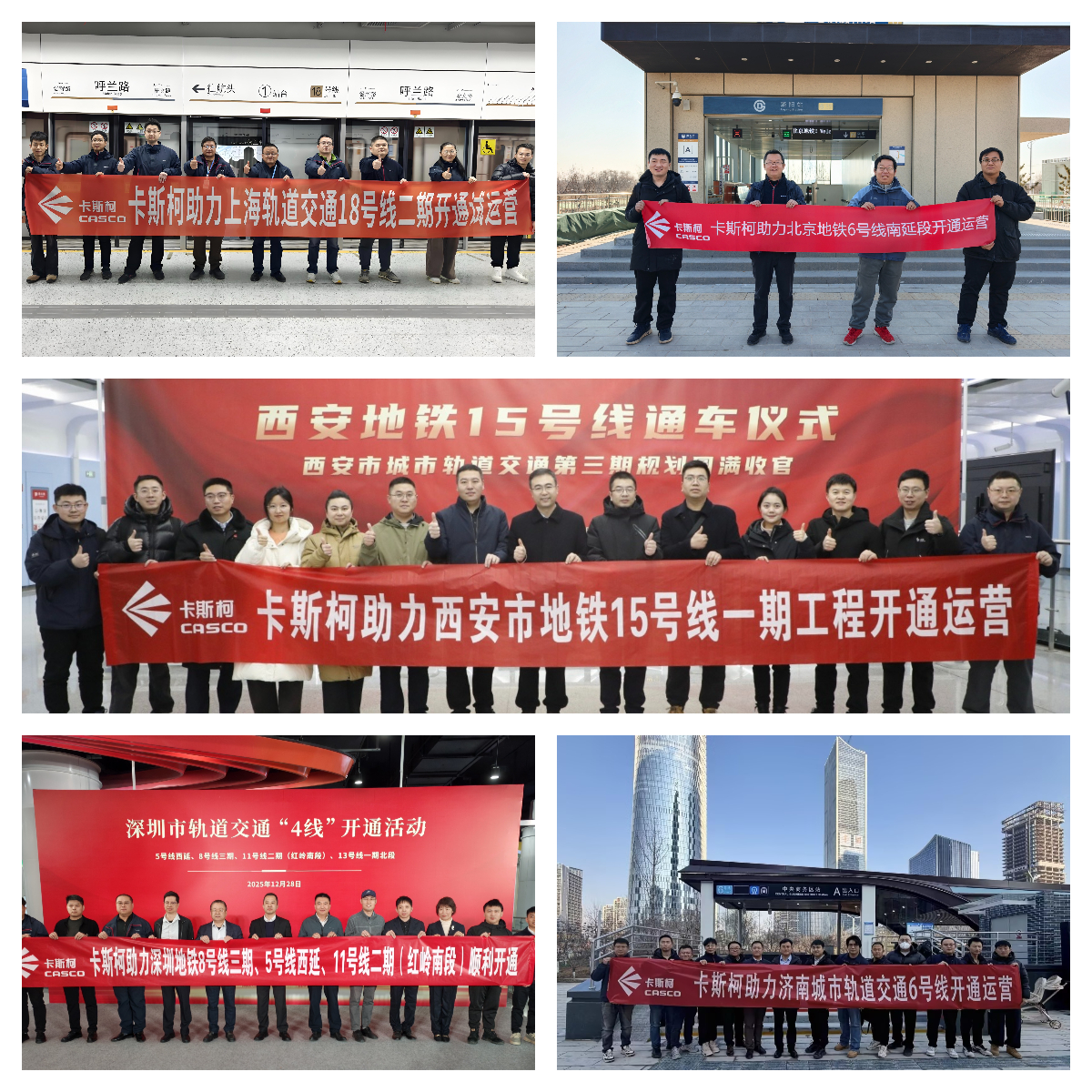
Xi'an Metro Line 15 Phase I began revenue service on December 29. The line spans 19.46 kilometers with 13 stations. CASCO provided UTO signaling system and undertook the consistency coordination work for relevant fully automatic disciplines. The system deployed a dispatching command and control hub on the cloud platform, and utilized domestic database software, key equipment technologies such as iLOCK-IIE all-electronic computer interlocking system, independent LEU, and domestic encoding odometer, achieving safe and efficient operation as well as system independence and controllability.
Shenzhen Metro Line 11 Phase II went into operation on December 28. As a "fast corridor" connecting Futian Central District and Luohu Core Area, it achieved a breakthrough of "small line, big value" with a length of 2.3 kilometers. After the line opens, the morning peak headway from Huaqiang South to Gangxia North towards Bitou will be reduced from 3 to 4 minutes to 2 minutes and 16 seconds, further enhancing the line's commuting capacity.
Shenzhen Metro Line 8 Phase III opened on December 28, with a total length of 3.69 kilometers, connecting a golden tourism corridor that traverses Nanshan, Futian, Luohu, Yantian, and Dapeng. Along with the opening of the extension line, the four- to six-train formation modification was completed, enabling cost reduction, efficiency enhancement, and more flexible operations for the line.
Shenzhen Metro Line 5 West Extension opened on December 28, with a total length of 2.88 kilometers. Connecting three core business districts—Hubei, Dongmen, and Grand Theater—it serves as a "golden link" that activates the commercial vitality of Luohu and plays a crucial role in the integration of urban commerce, culture, and life.
The eastern section of Jinan Metro Line 6 opened on December 27. CASCO provided UTO signaling system for it. With a total length of 19.5 kilometers and 17 stations, the line connects three major hubs—Jinan West Station, Jinan Station, and Jinan East Station, and offers convenient transfers with the existing Line 2 and Line 3. It will significantly improve the travel efficiency of residents along the line, strengthen regional economy, and inject new impetus into Jinan's urban development.
The southern extension of Beijing Metro Line 6 opened on December 27, with a total length of 2.066 kilometers. After the project opens, it will be fully connected with the existing Phase I, Phase II, and West Extension of Line 6, playing a significant role in alleviating regional traffic pressure, facilitating the relocation of non-capital functions, supporting the construction of the city's sub-center, and facilitating the travel of residents along the line.
Shanghai Metro Line 18 Phase II opened on December 27, with a total length of approximately 8.006 kilometers and 6 stations. As an UTO line, CASCO optimized functions such as abnormal platform screen door opening protection and automatic train holding due to platform screen door closing timeout across the entire line based on the original functions of the Phase I, further strengthening the safety assurance mechanism. After the connection of Phase I and Phase II, it will further improve the rail transit layout in northern Shanghai and support the development of areas along the line.
Eight High-Speed Railways Open in Succession, Accelerating the Construction of the "Eight Vertical and Eight Horizontal" Railway Network
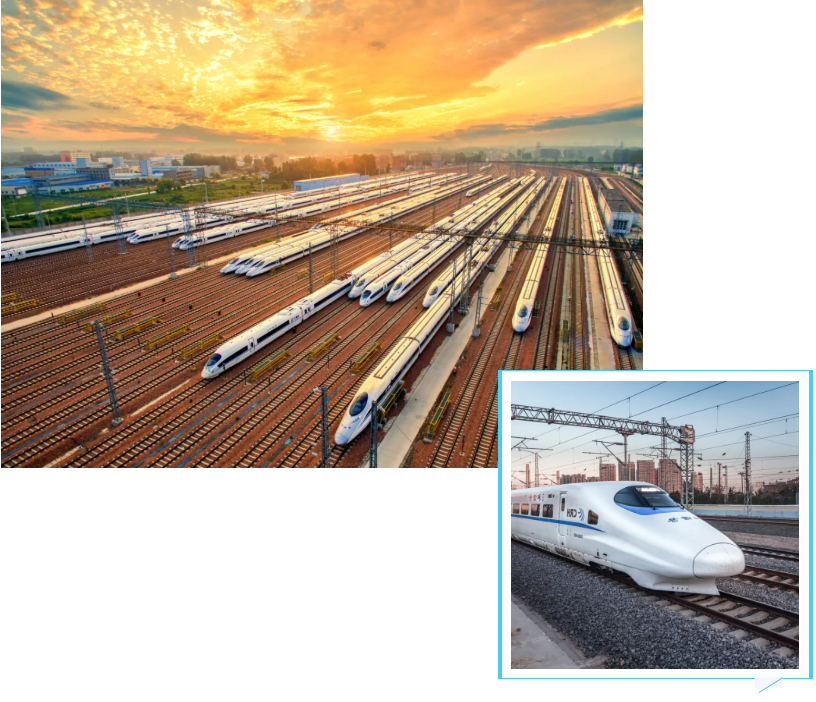
The Hefei-Xinxiang High-Speed Railway (Hefei to Sixian Section) opened on December 30, initially forming a new fast corridor connecting Central China with the coastal areas. It adopts the FZk-CTC3.0 centralized traffic control system.
The Shanghai-Chongqing-Chengdu High-Speed Railway (Wuhan to Yichang Section) opened on December 26, adding another transportation artery to the Yangtze River Economic Belt. It adopts the FZk-CTC3.0 centralized traffic control system.
The Yichang-Xingshan High-Speed Railway (Yichang East to Yangjiabang Section) opened on December 26, laying the foundation for connecting Shanghai-Wuhan-Chengdu High-Speed Railway with Zhengzhou-Wanzhou High-Speed Railway and opening up a new eastward corridor for Sichuan and Chongqing. It adopts the FZk-CTC3.0 centralized traffic control system and the iLOCK computer interlocking system.
The Xi'an-Yan'an High-Speed Railway opened on December 26, helping the revolutionary base area in northern Shaanxi connect to the national high-speed rail network. It adopts the FZk-CTC3.0 centralized traffic control system.
The Hangzhou-Quzhou High-Speed Railway opened on December 26, ushering the mountainous areas of western Zhejiang into the high-speed rail era and facilitating their deep integration into the Yangtze River Delta. It adopts the FZk-CTC3.0 centralized traffic control system.
The Baotou-Yinchuan High-Speed Railway (Baotou to Huinong Section) opened on December 23, opening up the Beijing-Lanzhou corridor of the "eight vertical and eight horizontal" high-speed rail network and reshaping the transportation pattern in the western region. It adopts the FZk-CTC3.0 centralized traffic control system and the signal centralized monitoring system.
The Shantou-Shanwei High-Speed Railway (Shantou South to Shantou Section) opened on December 22, successfully opening up the second high-speed rail corridor between eastern Guangdong and the Greater Bay Area. It adopts the FZk-CTC3.0 centralized traffic control system.
The Guangzhou-Zhanjiang High-Speed Railway opened on December 22, helping western Guangdong connect to the "1.5-hour economic circle" of the Greater Bay Area. It adopts the FZk-CTC3.0 centralized traffic control system.
These remarkable achievements not only serve as vivid footnotes to the rapid development of China's rail transit, but also reflect CASCO's sense of responsibility and commitment in fulfilling the mission of building a transportation powerhouse. Looking ahead, CASCO will continue to play a leading role in the industry, drive the development of the rail transit sector with advanced technologies, and create safer, more efficient, and better travel experiences for the public.